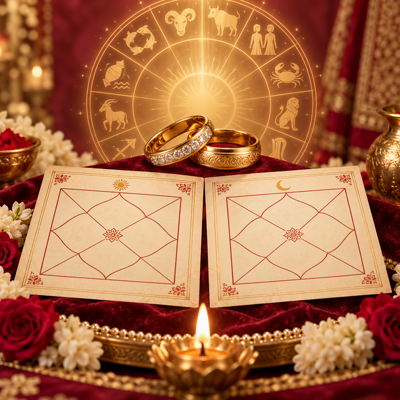
Personalized Marriage Compatibility and 36 Guna Analysis
Marriage is a meaningful partnership that brings together two individuals, their values, responsibilities, expectations, and families. Kundli Matching is a traditional Vedic astrology method used to study compatibility between two prospective partners before marriage.
Maa Kamakhya Devi provides personalized Kundli Milan by examining Ashtakoota Guna Milan, Mangal Dosha, planetary strength, emotional compatibility, the seventh house, Navamsha charts, and important planetary periods.
The purpose is to provide clarity and a broader perspective—not to guarantee a successful marriage or create unnecessary fear.
What Is Kundli Matching?
Kundli Matching (कुंडली मिलान), also called Horoscope Matching or Kundli Milan, compares the birth charts of two individuals who are considering marriage.
Traditional Kundli Matching may include:
- Ashtakoota 36 Guna Milan
- Varna compatibility
- Vashya compatibility
- Tara or Dina compatibility
- Yoni compatibility
- Graha Maitri
- Gana compatibility
- Bhakoot analysis
- Nadi analysis
- Mangal Dosha assessment
- Seventh-house analysis
- Venus and Jupiter analysis
- Navamsha chart comparison
- Mahadasha and Antardasha compatibility
- Emotional and practical relationship factors
A responsible analysis considers the complete birth charts rather than approving or rejecting a marriage only through the final Guna score.
Why Is Kundli Matching Important?
Kundli Matching may provide traditional insights into several areas of married life.
Emotional Compatibility
Understand how both individuals express feelings, respond to stress, and seek emotional support.
Mental Compatibility
Explore communication styles, decision-making patterns, intellectual understanding, and personal expectations.
Physical Compatibility
Traditional factors may be examined to understand attraction, comfort, temperament, and physical compatibility.
Family Compatibility
Consider values, family responsibilities, household expectations, cultural background, and long-term priorities.
Financial Understanding
Review planetary patterns connected with income, savings, expenses, career goals, and financial responsibilities.
Marriage Stability
Examine the seventh house, relevant planets, Navamsha charts, and current planetary periods.
Health and Well-Being
Traditional compatibility factors may be reviewed, but astrology cannot diagnose health conditions or replace medical advice.
Children and Family Planning
Relevant traditional planetary combinations may be examined without making guaranteed predictions regarding conception or childbirth.
Detailed Ashtakoota 36 Guna Milan
Ashtakoota Milan compares eight traditional compatibility categories with a combined maximum score of 36 Gunas.
Varna – 1 Guna
Varna is traditionally associated with values, spiritual outlook, ego compatibility, and personal approach.
Vashya – 2 Gunas
Vashya considers mutual influence, cooperation, attraction, and the balance of decision-making within the relationship.
Tara – 3 Gunas
Tara or Dina is traditionally connected with well-being, fortune, and supportive life patterns.
Yoni – 4 Gunas
Yoni considers physical compatibility, attraction, intimacy, temperament, and instinctive behaviour.
Graha Maitri – 5 Gunas
Graha Maitri examines friendship between the ruling planets of the Moon signs and is associated with mental understanding and communication.
Gana – 6 Gunas
Gana compares temperament and behavioural nature through Deva, Manushya, and Rakshasa classifications.
Bhakoot – 7 Gunas
Bhakoot is traditionally connected with emotional harmony, family life, prosperity, and long-term relationship development.
Nadi – 8 Gunas
Nadi has the highest score and is traditionally examined in relation to constitution, compatibility, and family concerns.
The total score is only one part of the analysis. A higher score does not guarantee a successful marriage, and a lower score does not automatically mean the relationship will fail.
How Many Gunas Should Match?
Traditionally, the score may be interpreted as follows:
- Below 18 Gunas: Requires detailed analysis of both birth charts
- 18–24 Gunas: Generally considered an acceptable score
- 25–32 Gunas: Traditionally considered good compatibility
- 33–36 Gunas: Traditionally considered strong Guna compatibility
These ranges should not be used as the only basis for a marriage decision.
The astrologer should also examine:
- Mangal Dosha and cancellation conditions
- Nadi and Bhakoot cancellation
- Seventh house and seventh-house lord
- Venus and Jupiter
- Moon and emotional compatibility
- Navamsha charts
- Mahadasha and Antardasha
- Longevity of relationship patterns
- Personal values and practical circumstances
Mangal Dosha Analysis
Mangal Dosha, also called Manglik Dosha or Kuja Dosha, is traditionally assessed through the position of Mars in the birth chart.
A detailed analysis considers:
- Position of Mars in both charts
- Strength and dignity of Mars
- Planetary conjunctions and aspects
- Placement from Lagna, Moon, and Venus
- Manglik status of both partners
- Cancellation or reduction conditions
- Navamsha position of Mars
- Overall strength of the seventh house
Mangal Dosha should never be judged through a general calculator or a single planetary placement. Many traditional exceptions and balancing conditions may reduce or modify its effects.
Nadi Dosha and Bhakoot Dosha
Nadi Dosha
Nadi Dosha may appear when both individuals belong to the same Nadi classification. However, Nakshatra, Pada, planetary strength, and traditional cancellation conditions must also be examined.
Bhakoot Dosha
Bhakoot Dosha relates to the Moon-sign relationship between both partners. Its effect may be reduced or cancelled depending on the friendship of sign lords, Nakshatra compatibility, and other planetary factors.
Neither Nadi nor Bhakoot Dosha should be considered independently from the complete horoscopes.
Complete Marriage Compatibility Analysis
Seventh House
The seventh house represents marriage, committed partnership, companionship, and cooperation. Its lord, placement, aspects, and strength are examined in both charts.
Venus
Venus represents affection, attraction, harmony, comfort, and relationship expectations.
Jupiter
Jupiter is connected with wisdom, values, growth, guidance, and long-term stability.
Moon
The Moon represents emotions, habits, mental peace, sensitivity, and emotional responses.
Mars
Mars represents passion, energy, initiative, anger, impatience, and conflict.
Navamsha Chart
The Navamsha or D9 chart is examined for marriage, partnerships, maturity, Dharma, and the deeper strength of planets.
Planetary Periods
Mahadasha and Antardasha may indicate how both individuals’ life periods interact during the early and later stages of marriage.
Areas Covered in Your Consultation
36 Guna Milan
Complete Ashtakoota calculation with an explanation of all eight compatibility factors.
Mangal Dosha
Detailed Manglik assessment, including traditional cancellation and balancing conditions.
Emotional Compatibility
Analysis of the Moon, Moon signs, Nakshatras, and emotional tendencies of both individuals.
Communication Compatibility
Examination of Mercury, the second house, and planetary patterns connected with expression and understanding.
Marriage Stability
Review of the seventh house, seventh-house lord, Venus, Jupiter, Navamsha, and planetary periods.
Family and Financial Compatibility
Traditional analysis of family values, financial habits, career responsibilities, and household expectations.
Challenging Yogas and Doshas
Important combinations are explained in context without creating unnecessary fear.
Supportive Planetary Periods
Mahadasha, Antardasha, and transits may be examined to understand comparatively supportive periods for marriage planning.
Kundli Matching Beyond the Guna Score
A successful marriage depends on much more than an astrological score.
Before making a decision, both partners should openly discuss:
- Personal values and beliefs
- Career plans
- Financial expectations
- Living arrangements
- Family responsibilities
- Children and family planning
- Health considerations
- Lifestyle preferences
- Communication habits
- Personal boundaries
- Long-term goals
- Expectations from marriage
Kundli Matching should support thoughtful discussion—not replace personal understanding or informed consent.
Personalized Vedic Guidance
If the charts show challenging planetary combinations, Maa Kamakhya Devi may suggest suitable non-harmful spiritual practices.
Personalized Mantra
An appropriate Vedic mantra may be recommended according to the planets influencing marriage and emotional harmony.
Gauri-Shankar Prayer
Traditional prayers associated with mutual understanding and marital harmony may be suggested according to personal beliefs.
Navagraha Shanti
Navagraha practices may be considered when multiple planetary influences require balanced spiritual attention.
Mangal-Related Practices
Prayer, charity, discipline, and other traditional practices may be suggested when Mars requires attention.
Jupiter and Venus Practices
Suitable spiritual practices may be recommended to support wisdom, maturity, affection, and responsible commitment.
Meditation and Communication
Meditation, patience, honest communication, and premarital counselling may be encouraged.
No Puja, mantra, gemstone, Yantra, or fasting practice can guarantee a successful marriage or change another person’s behaviour.
How Kundli Matching Works
1. Share Both Partners’ Details
Please provide for both individuals:
- Full name
- Date of birth
- Exact time of birth
- Place of birth
2. Birth-Chart Preparation
Both Kundlis are prepared using accurate birth details.
3. Compatibility Analysis
The 36 Gunas, Mangal Dosha, seventh house, Moon, Venus, Jupiter, Navamsha, and planetary periods are examined.
4. Private Consultation
The findings are explained through a confidential phone or WhatsApp consultation.
5. Personalized Guidance
Supportive factors, areas requiring discussion, and suitable spiritual practices may be explained.
All birth details and personal information are treated respectfully and confidentially.
Why Consult Maa Kamakhya Devi?
- Personalized Kundli Matching
- Complete Ashtakoota 36 Guna Milan
- Detailed Mangal Dosha analysis
- Nadi and Bhakoot evaluation
- Seventh-house analysis
- Moon, Venus, Jupiter, and Mars assessment
- Navamsha chart comparison
- Mahadasha and Antardasha review
- Clear explanation of compatibility factors
- No fear-based rejection of marriage
- Private phone or WhatsApp consultation
- Respectful and confidential guidance
Frequently Asked Questions
What is Kundli Matching?
Kundli Matching is a traditional Vedic astrology process used to compare two birth charts for marriage compatibility.
Is 18 Gunas enough for marriage?
A score of 18 or more is traditionally considered acceptable, but the final decision should not be based only on the score. The complete Kundlis and practical compatibility should also be examined.
Does a high Guna score guarantee a successful marriage?
No. A high score does not guarantee happiness or marriage stability. Communication, respect, trust, shared values, and mutual effort remain essential.
Does a low score mean the marriage should not happen?
Not necessarily. Supportive planetary combinations, Dosha cancellation, Navamsha strength, and practical compatibility may change the overall interpretation.
Can Manglik and non-Manglik people marry?
A complete analysis is required. The strength of Mars, cancellation conditions, both Kundlis, and other marriage factors should be examined before reaching a conclusion.
What is Nadi Dosha?
Nadi Dosha may arise when both individuals have the same Nadi classification. Traditional cancellation conditions and the complete birth charts must also be studied.
Are birth times required for matching?
Accurate birth times are strongly recommended because they determine the Ascendant, houses, and divisional charts.
Can Kundli Matching predict divorce?
Astrology may indicate challenging relationship patterns, but it cannot guarantee separation or divorce. Personal choices and circumstances remain important.
Should Kundli Matching be the only basis for marriage?
No. Both individuals should also consider values, consent, communication, health, finances, family expectations, and long-term goals.
Is the consultation confidential?
Yes. Both partners’ birth details and personal information are handled respectfully and confidentially.